
Optimization is central to communications, transportation, engineering design and machine learning. Cohesing brings together new physical processors, mathematical understanding of their dynamics, practical applications and rigorous evaluation.
The collaboration grew from the 2020 NSF Expedition in Coherent Ising Machines, originally announced as a five-year, $10 million effort. This site follows the research and people associated with that collaboration, including subsequent publications acknowledging NSF award 1918549.
The core project institutions are Stanford University, California Institute of Technology, Cornell University, NTT Research, Universities Space Research Association and NASA Ames. Recent papers show how these groups connect with additional academic and industry collaborators.
A collaboration spanning devices, algorithms and people.
Reviewed October 2, 2026. These examples link to their original research records.
- Photonic systems: programmable nonlinear photonics and multimode waveguides connect Cornell, NTT Research and Stanford. Caltech-led work demonstrates all-optical recurrent processing, with waveguide contributions acknowledged from Fejer and Langrock.
- Foundations: Mabuchi, Ganguli and collaborators examine geometric landscape annealing and its extension to hidden and planted solutions. Quantum-optics work investigates loss in broadband optical cavities.
- Optimization and applications: Cornell, Princeton and USRA study parallel probabilistic Ising processing for applications including wireless detection. A collaboration involving Pavone and Brown extends variational quantum optimization to polynomial objectives.
- Benchmarking: researchers at USRA, NASA Ames, Stanford, Purdue and UCLA develop operational comparisons of stochastic solvers that account for the cost of parameter tuning.
- People and computing: grant-supported work includes training pathways and Vassel and collaborators’ study of representation in language-model narratives. This complements the collaboration’s broader education and participation agenda.
What is a coherent Ising machine?
A coherent Ising machine represents binary variables using optical oscillator states and encodes an optimization problem through their interactions. Driving and coupling the oscillators creates a physical search process. The quality and cost of the resulting solutions depend on the dynamics, implementation and problem being solved.
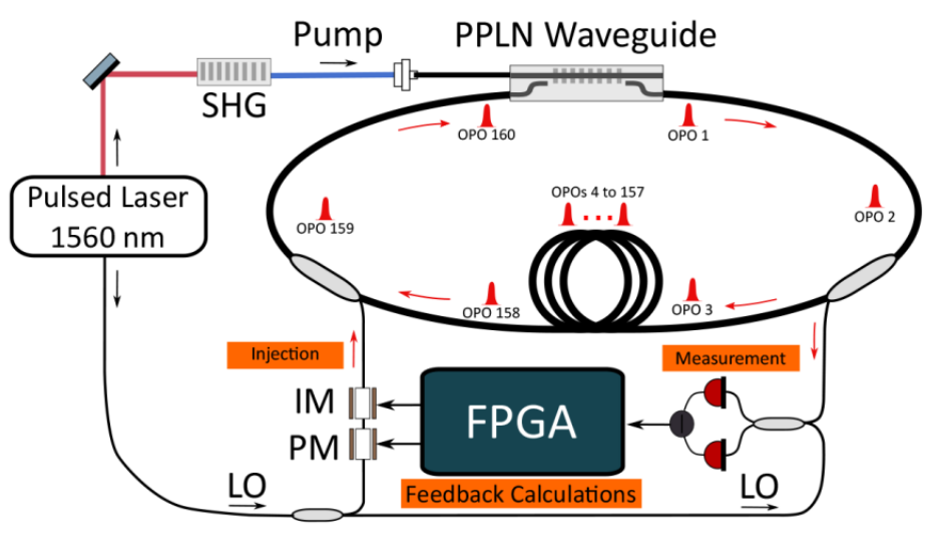
Coherent Ising machines are part of a wider family of physical computing approaches. Evaluating them against relevant classical methods requires comparable resource accounting. Optical coherence alone does not establish quantum computational advantage.
For context, see Ising machines as hardware solvers of combinatorial optimization problems (2022) and The physics of optical computing (2023). The publication archive links journal records, preprints and project-attribution evidence.